Showing posts with label vintage cookery. Show all posts

24 September 2014

Breakfast in the 1970s


So far on this blog I've looked at cookbooks from the 1930s that emphasised the value of thrift, seasonal shopping and reducing waste for the 'squeezed middle' between the Wars. However, by the 1970s food had started to look more like the stuff we eat today, albeit a bit more orange in many cases. Moreover, the idea of eating and food as an aspirational activity rather than a re-fuelling exercise seems to have returned in earnest.

This book, published by Hamlyn in 1976 and sponsored by Brooke Bond/Oxo, shows how eating was reflecting a wealthier and more leisured ideal of family life.
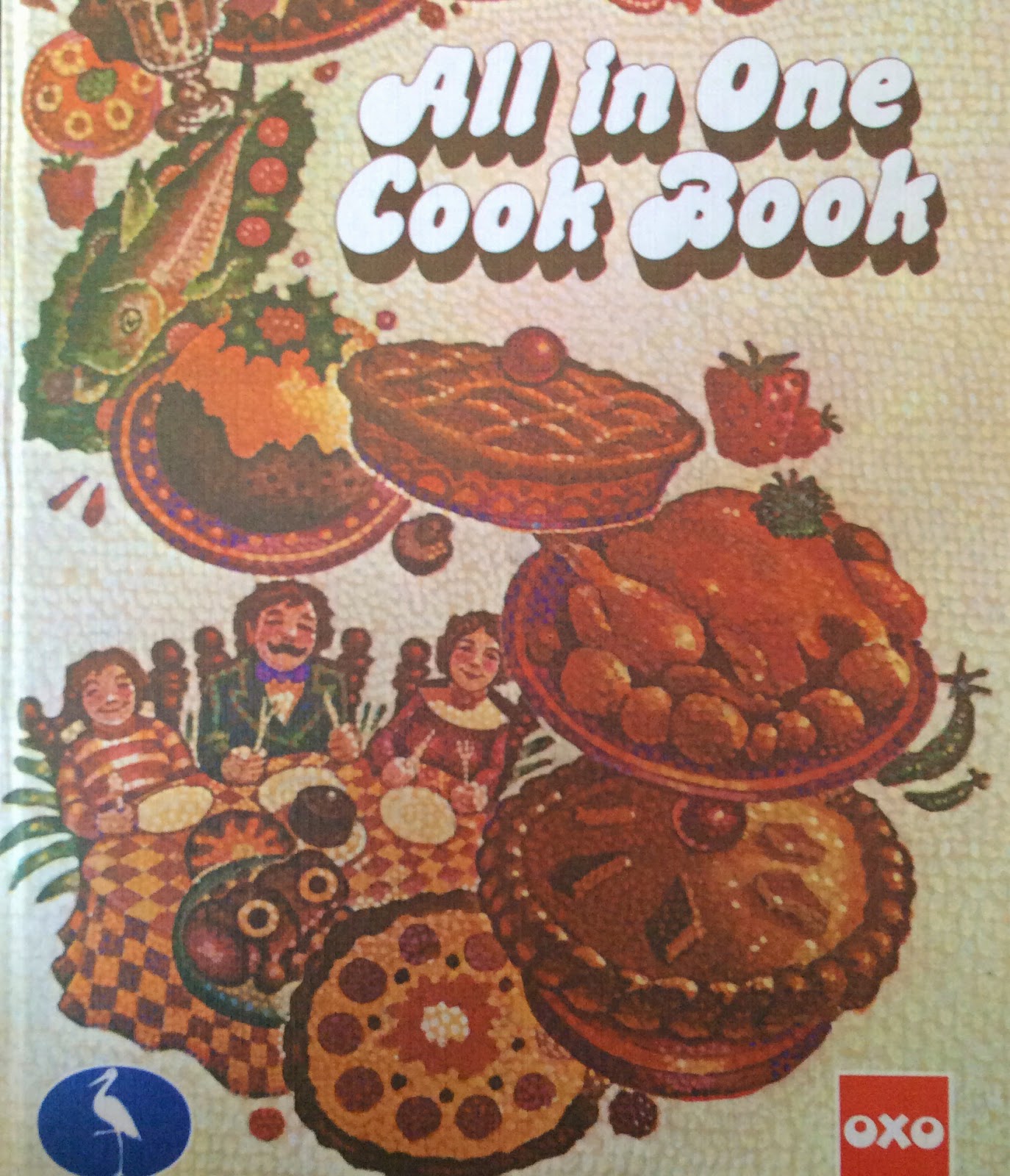


Gone are the sections on feeding invalids who presumably with the success of the NHS were a rarity in the spare bedroom by 1976, and in come sections on entertaining at home. Dishes and cutlery are from brands, largely associated with 'groovy' new design, and name checked at the beginning of the book so you can replicate the tables you see photographed: Heal's, Habitat, Casa Pupo, Elizabeth David, John Barker, Selfridges, Conran, Josiah Wedgewood and Sons Ltd. Food is photographed as a package along with the accessories, with backdrops that include salmon mousse placed artfully on a jetty at Nauticalia, Shepperton that are meant to suggest aspirational middle-class lifestyles.

It's a far cry from meat paste sandwiches at a drop leaf table in the living room.

Let's start with our weekend 70s breakfast or brunch, which the book explains to an audience almost certainly unfamiliar with such a concept (actually late rising is also probably a fairly alien idea too) as a "combined breakfast and lunch which saves cooking two meals",  in which muesli makes a star appearance as well as the classic kedgeree.


Muesli would have been a hard sell to the men in my family, who in the 1970s still expected cooked breakfasts, and I'm pretty sure that coffee served instead of tea would have raised a few eyebrows.

However, cheap foreign travel and money to spare for the older members of the family meant that even families like mine became aware of the 'continental breakfast' as a roll, some butter and jam and a weak coffee was dubbed.

The blurb that goes with this also reminds us that by now the figure of the  'slimmer' had appeared at the table - a concept hardly necessary in the cash-strapped or rationed years of previous cookbooks in the collection.

I recall the women in my family going through all the faddy diets of the 70s and 80s to little effect (remember the F-Plan - obviously the family joke was what the F stood for). So while "hungry men and children" were still getting bacon and eggs at the breakfast table (in nicer dishes now - I rather like all the crockery in these pictures, I have to say) with fried bread, the ladies of the house were nibbling oats and apples and having tea with lemon.


The recipes for breakfast actually look quite nice despite the shoe-horning of Stork margarine and/or Oxo cubes into many of them - not thankfully the muesli- although kidney omelettes would be an unlikely breakfast find these days.

Time to don the kaftan perhaps and whip up some kipper toasts...

9 September 2014

Makes it beefy - the royal tonic invented by a German chemist that became a kitchen staple


There are a number of books in Mum's collection that were issued by food companies as part of their marketing. One such is Cooking the Oxo Way, which probably dates from the 1950s, or perhaps a little earlier.

It has recipes for main courses, pies and puddings that are all enhanced by the addition of an Oxo cube. I'm not convinced by the sandwiches section which recommends making Oxo butter - 1oz of butter to 1/2 an Oxo cube - but what do I know? I'm sure it does give 'zest to fillings' and definitely crusts on...who wants a dainty sandwich when you're using Oxo butter?


Part of the pleasure of this little project is following up unfamiliar references, via the power of Google and Wikipedia, and opening up a whole world of new knowledge about the everyday and the commonplace in our lives, which often prove to be far from commonplace in their origins.

The humble Oxo cube has a noble history which begins in Hesse, now Germany, in 1840. Let's start with the advert at the front of the book for the Liebig's Extract of Meat Company, the parent company of Oxo Ltd, which boasts of factories from Montreal to Dar-Es-Salaam.


The 'father of the Oxo cube' and, incidentally Marmite, was the celebrated 19th century German chemist, Justus von Liebig,  a remarkable man born in Hesse whose work transformed scientific education and agriculture as well as inventing a way to give "added strength and savour" to your meat dishes. Liebig lived through the year without a summer of 1816, which hit Hesse very hard and was said to have shaped much of the scientist's work. Amongst his many achievements was the development of a manufacturing process for beef extract and, helped by George Christian Giebert, a young Belgian engineer, the founding of the Liebig Extract of Meat Company, using South American cattle. European cattle had proved to be too expensive and so, until Giebert's suggestion, the extract had been used as a tonic dispensed by the royal pharmacy.

The plant was owned by the Societe de Fray Bentos Giebert & cie which, by 1875, was producing 500 tonnes of extract, as the extract grew in popularity and became a staple of kitchens, soldiers' rations and was even found in the trunks of European adventurers like Livingstone. Fray Bentos began to manufacture frozen, chilled and, of course, corned beef. Our little book has a nod to this in the advert on the back of the booklet for Fray Bentos soups and pastes which "will captivate the palate of all those who appreciate savouriness at its best" (don't you love the advertising language of the past?- which company tries to 'captivate a palate' these days?)


The Oxo cube went into production in 1910 increasing the popularity of the product, as the cubes were cheaper than the liquid. In the 1920s, Oxo became part of the London landscape with the acquisition of premises on the South Bank and the building of the familiar tower. Its architect, Albert Moore, incorporated the design as windows on the tower to get around a ban on skyline advertising. By1924,  the Liebig Co. and its tower was taken over by the Vestey group, who would have owned the company at the time our book was published.


Thus, a little book produced for marketing 50 years ago which sat tucked away on Mum's bookshelf hints at a bigger story of chemistry, commerce, and cattle farms in Uruguay. It begins with a young man experiencing famine in Germany leading to a little red box of beefy cubes in your store cupboard. Times and food fashions may change but we all still have them tucked away somewhere. Does anyone still, as the book recommends on the last page,"slip one or two Oxo cubes in your pocket and be ready to make a beefy drink at any time."?

Read more
Justus Von Liebig on Wikipedia
Oxo (Wikipedia)
Darkness by Lord Byron (about 1816, the year without a summer)
10 things about Marmite


5 September 2014

Making chocolate rock cakes like a 1930s housewife


The simplicity of the recipes in Lydia Chatterton's Modern Cookery (Illustrated) is encouraging me to get my baking trays out and have a go at some of the cake recipes in my grandmother's cookbooks.

Although second hand book websites give the date of this book as anything from 1917 to 1951, my guess is that this is one of a number of cookbooks that my grandmother bought as a housewife in the 1930s. The pictures also suggest that this copy, at least, dates from that period.


I've made rock cakes before but never chocolate ones. I whipped these up in less than 20 minutes including cooking time. The result was a slightly biscuity cake that the kids devoured in seconds.


Next time I cook them though, I'm tempted to take a 21st century liberty with the recipe and add some chocolate bits to the mixture for a little extra taste.